
Too many procurement managers lose time and money on the wrong supplier. The real cost isn't the parts. It's the warranty claims, stockouts, and damaged brand reputation that follow1.
Choosing a reliable sway bar link supplier is a process of matching a supplier's production capability, quality control system, and market experience to your specific business needs. There is no single "best" supplier. The right supplier is the one that fits your target market, vehicle applications, and quality standards.
After more than 20 years of working directly with procurement managers, brand owners, and distributors across 100+ countries2, I've seen the same mistakes made over and over again. This article is what I tell buyers before they make a decision they'll regret. If you're currently evaluating suppliers, read this first.
Does "Reliable" Mean the Same Thing for Every Buyer?
Most buyers start their search with the same phrase: "We need a reliable supplier." But when I ask what reliable means to them specifically, many struggle to answer. That gap is where supplier mismatches happen.
"Reliable" is not a universal standard. It depends entirely on your market, your customers, and the vehicles you serve. A supplier that works perfectly for a European passenger car brand may be completely wrong for a heavy-duty truck parts wholesaler in South America.
I once spoke with a buyer who had been sourcing sway bar links from a manufacturer with clean certifications and good-looking spec sheets. The problem? The parts kept failing in the field. The root cause was simple: the supplier had no real experience with the road conditions or vehicle load requirements in that buyer's market.
Before you evaluate a single supplier, you need to define what reliability means for your business. Ask yourself these questions:
| Business Context | What "Reliable" Looks Like |
|---|---|
| Passenger car brand in Europe | OE-spec fitment, tight dimensional tolerances, consistent finish quality3 |
| Aftermarket wholesaler in South America | Durability on rough roads, cost-effectiveness, broad vehicle coverage |
| Heavy-duty truck parts distributor | High load capacity, fatigue resistance, long service life under stress4 |
| Private label brand in Southeast Asia | Flexible packaging, stable supply, competitive unit cost |
The answers to these questions shape every decision that follows. Fit your definition of reliability to your market first. Then go find the supplier that matches it.
Are You Asking the Right Questions About Quality Control?
This is where I see the most critical mistakes. A common mistake we see buyers make is asking about product specifications instead of asking about process consistency. These are two very different things.
Asking "what is your pull-out force?" tells you about one test result. Asking "how do you ensure pull-out force consistency across a 50,000-piece order?" tells you about the supplier's entire quality control system. The second question is the one that protects your business.
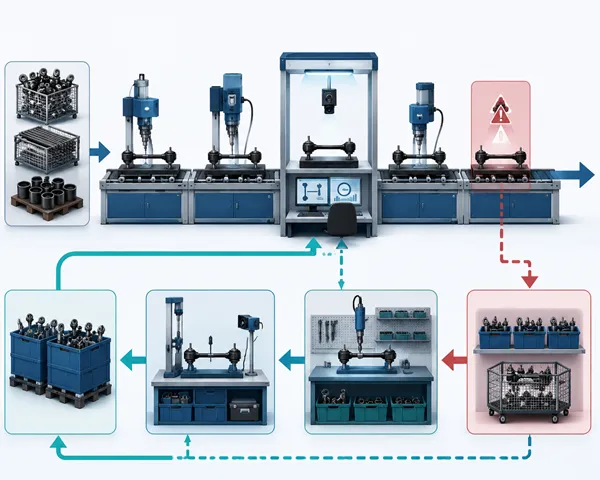
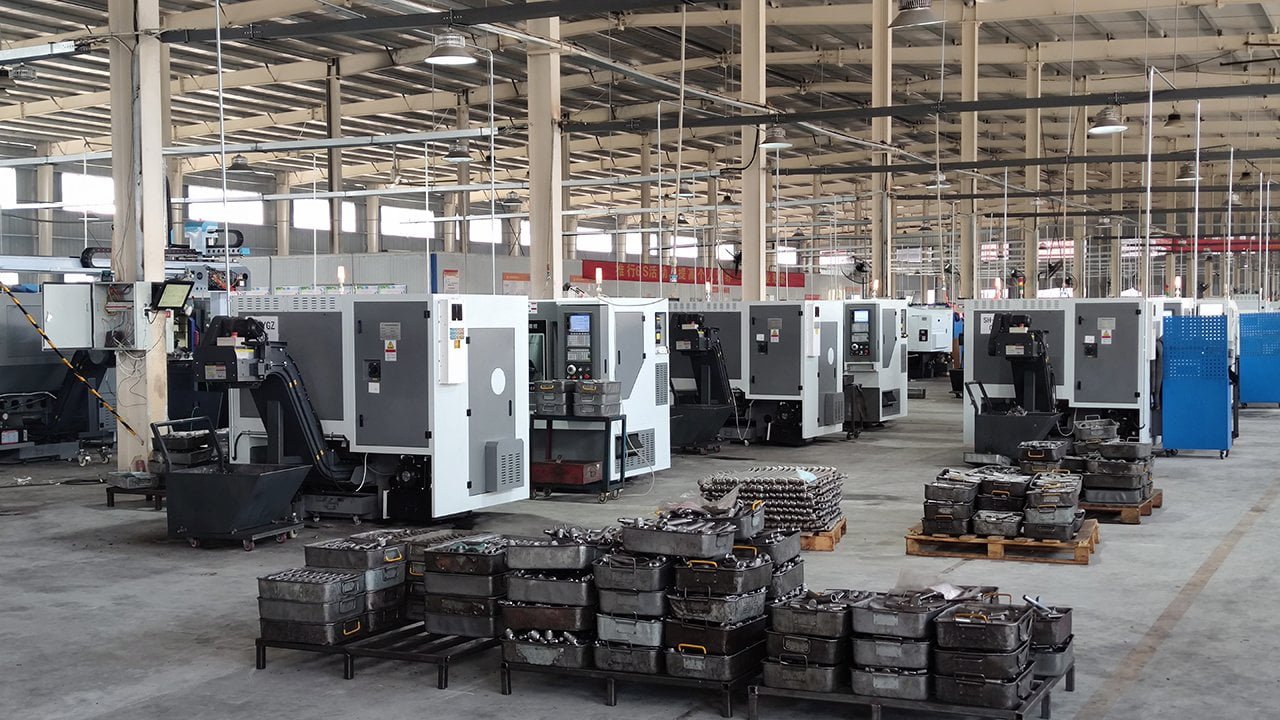
A spec sheet is easy to produce. Process consistency is hard to fake. When I walk buyers through our quality control setup at GDST, I don't start with a list of tests. I start by showing them how our QC team monitors the production line, where raw materials come from, and what happens when a deviation is found.
Here is what an experienced procurement manager will always ask about:
Raw Material Sourcing
Ask which steel mills the supplier uses. At our factory, we source from mills like Baosteel, Shagang, and Yuanli, and we receive material inspection reports with every batch. We also run random chemical composition tests internally. This matters because the steel grade directly affects fatigue life and corrosion resistance5. A supplier who cannot name their steel source is a supplier who cannot guarantee what's inside their parts.
Batch Testing Procedures
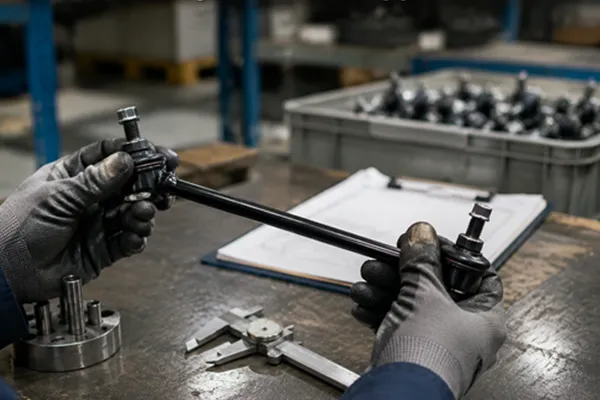
Ask how testing is done across a production run, not just on samples. Key tests for sway bar links include pull-out and compression force6, salt spray resistance, fatigue cycling, torque testing, and angle testing7. But the real question is: how many units are tested per batch, and what triggers a hold or rejection?
Dimensional Control
Ask about their tolerance standards. Our molds are developed to OE specifications, and we control dimensional tolerances within ±0.2 mm8. This level of control matters directly for fitment accuracy. A part that is slightly off will cause installation problems in the field, and that cost lands on you, not the manufacturer.
Final Inspection Protocol
Ask what happens before a shipment leaves the factory. A strong supplier will have a written final inspection procedure that covers product condition, quantity, packaging, labeling, and pallet integrity. These are not bureaucratic steps. They are the last line of defense before a problem ships to your warehouse.
Does Your Supplier Know Your Market?
Technical capability is necessary. But it is not enough. I have seen suppliers with excellent equipment and certifications who still failed their buyers in the field. The reason was almost always the same: they had no real experience with the target market.
A supplier who has already served your region understands your local vehicle fleet, common failure points, and the packaging and shipping requirements specific to your market. This experience reduces your risk far more than any certificate does.
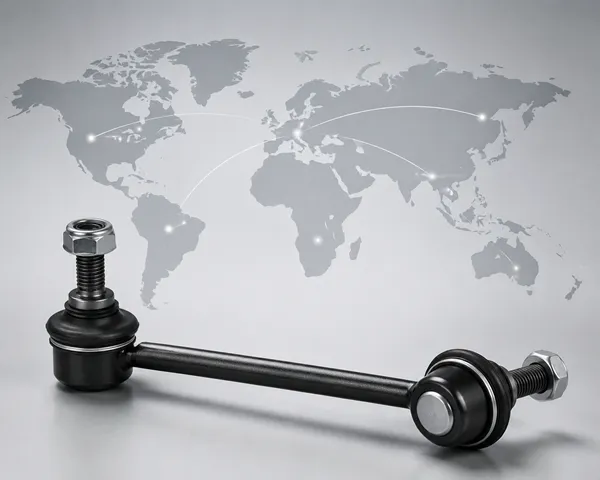
When a buyer from a new region approaches us, one of the first things I do is check whether we have existing customers in similar markets. Not because it's a sales pitch, but because shared market experience is genuinely valuable. A supplier who has shipped to Brazil knows about humidity and road vibration9. A supplier who serves the Middle East understands extreme heat cycles10. That knowledge shows up in product recommendations, material choices, and packaging decisions.
Here's how to probe for real market experience during supplier evaluation:
Ask for Regional References or Case Studies
A credible supplier should be able to describe a specific scenario where they solved a problem for a customer in a similar market. Not a generic testimonial. A real situation with a real challenge and a clear outcome.
Ask About Vehicle Coverage for Your Applications
Request a vehicle fitment list that covers your target models. If you serve Japanese, Korean, American, or European vehicles, confirm the supplier has active production coverage for those applications. At GDST, we cover all four markets, including passenger cars, SUVs, and light-to-heavy-duty trucks. Breadth of coverage matters because it reflects actual production experience, not just the ability to take on a new order.
Ask About Common Failure Patterns in Your Region
A supplier with genuine field experience will be able to tell you what types of failures they've seen from parts returning from your target market, and what they changed as a result. This is a conversation a parts catalog cannot have with you.
| Market Region | Common Risk Factors | What to Look for in Supplier Experience |
|---|---|---|
| South America | Rough roads, load stress, humidity | Durability testing, corrosion resistance, broad coverage |
| Middle East | Extreme heat, UV exposure | Material heat resistance, grease specification, seal performance |
| Europe | OE fitment standards, strict regulations | Dimensional accuracy, IATF16949 compliance11, documentation |
| Southeast Asia | Mixed fleet, price sensitivity | Vehicle coverage depth, flexible MOQ, packaging options |
Market experience is not a bonus feature. It is a core part of supplier reliability.
Is Your Supplier a Vendor or a Long-Term Partner?
This question sounds soft. It is not. The difference between a vendor and a partner becomes very clear the moment something goes wrong in the field.
A vendor sells you parts. A partner helps you solve problems. When a warranty claim comes back from your market, you need a supplier who will investigate the cause with you, not one who stops responding after the invoice is paid.

I have had calls with buyers who were dealing with field failures from a previous supplier. In most cases, the supplier had gone quiet. No root cause analysis12. No corrective action. Just silence. That silence is extremely costly for a brand or distributor. It means you absorb the warranty cost, the customer complaint, and the reputation damage, all alone.
When evaluating whether a supplier can be a long-term partner, look at these specific areas:
Communication Responsiveness
How fast do they respond to your inquiries? How clear and technically accurate are their answers? A supplier who takes days to reply to a sample request is showing you how they will respond to a field issue. This is a preview, not a one-time situation.
Technical Support Capability
Can they help you identify fitment issues? Can they provide technical documentation, drawing comparisons, or installation guidance if your customers need it? This level of support is standard for a strong manufacturing partner.
Customization and Private Label Support
If your business depends on your own brand, your supplier must support private labeling, custom packaging, and sometimes product-specific modifications. At GDST, we support OEM/ODM projects from product development through to mass production. We also have an in-house design team for packaging customization. This flexibility is not a luxury for growing brands. It is a basic requirement.
Willingness to Share Process Information
A partner is transparent. They will share their QC documents, explain their raw material sourcing, and walk you through their production process. A vendor will give you a product brochure and a price list. These two responses tell you everything about the relationship you are about to enter.
| Vendor Behavior | Partner Behavior |
|---|---|
| Sends catalog and price list | Asks about your vehicle applications first |
| Shares spec sheets only | Explains quality control process in detail |
| Goes quiet after delivery | Follows up on field performance |
| Offers fixed packaging only | Supports custom label and packaging design |
| No root cause analysis on returns | Investigates, reports, and corrects |
The goal of choosing a supplier is not to complete a transaction. It is to build a supply chain that supports your business long-term.
Conclusion
Define what reliability means for your market first. Then probe process quality, market experience, and partnership capability. That process will find you the right supplier.
"Supply chain disruptions and resilience: a major review and future ...", https://pmc.ncbi.nlm.nih.gov/articles/PMC7792559/. Research on total cost of ownership in supply chain management consistently identifies warranty liability, stockout penalties, and reputational harm as significant indirect costs of supplier failure, often exceeding the value of the defective components themselves. Evidence role: general_support; source type: paper. Supports: That the total cost of poor supplier quality extends well beyond purchase price to include warranty, disruption, and reputational costs. Scope note: Most published studies address manufacturing supply chains broadly; direct data specific to automotive aftermarket sway bar links is not available in the open literature. ↩
"Automotive Trade Data - International Trade Administration", https://www.trade.gov/automotive-trade-data. Industry analyses by organizations such as the Automotive Aftermarket Suppliers Association (AASA) and CLEPA document that the global automotive aftermarket encompasses over 100 national markets, each characterized by distinct vehicle parc compositions, infrastructure conditions, and import regulations that affect component specification requirements. Evidence role: historical_context; source type: institution. Supports: That the global automotive aftermarket spans a large number of distinct national markets with materially different vehicle fleets, road conditions, and regulatory environments. Scope note: Published market reports vary in country-count methodology and are often produced by commercial research firms; figures should be treated as indicative rather than precise. ↩
"Understanding ECE Regulation 10 and E-Mark EMC Requirements", https://www.intertek.com/resources/webinars/2026/automotive-ece-regulation-10-and-e-mark-emc-requirements/. European Union regulations and ECE type-approval frameworks establish baseline safety and fitment requirements for replacement automotive parts sold in European markets, with industry bodies such as FISITA and CLEPA further promoting OE-equivalent quality standards for aftermarket components. Evidence role: general_support; source type: government. Supports: That the European automotive aftermarket operates under regulatory and industry frameworks that impose defined quality and fitment standards on replacement parts. Scope note: Regulatory requirements set minimum safety thresholds; OE-equivalent dimensional and finish standards in the aftermarket are largely enforced through commercial rather than statutory mechanisms. ↩
"[PDF] The Need for Additional Heavy Truck Crashworthiness Standards", https://www.nhtsa.gov/sites/nhtsa.gov/files/rept2congress-need-for-addl-heavy-truck-crashworthiness-stds.pdf. Vehicle dynamics and fatigue engineering literature establishes that commercial truck suspension systems experience significantly higher axle loads and load cycle frequencies than passenger vehicles, necessitating elevated fatigue life targets and more robust material specifications for suspension link components. Evidence role: mechanism; source type: paper. Supports: That heavy-duty commercial vehicle suspension components are subjected to substantially higher cyclic loads than passenger car equivalents, requiring different material and design specifications. Scope note: Specific fatigue life requirements vary by OEM and application; no single public standard defines universal thresholds for heavy-duty sway bar links across all vehicle classes. ↩
"[PDF] Study of the corrosion fatigue resistance of steel grades for ... - OSTI", https://www.osti.gov/etdeweb/servlets/purl/20671829. Materials engineering literature establishes that steel alloy composition—including carbon content, manganese, and chromium levels—directly governs fatigue strength and corrosion resistance in load-bearing automotive components, making mill-certified material traceability a standard quality assurance requirement. Evidence role: mechanism; source type: paper. Supports: That steel alloy composition and grade selection materially influence fatigue life and corrosion resistance in structural automotive components. Scope note: Published studies typically address steel grades in general structural or bearing applications; peer-reviewed data specific to sway bar link geometry and loading profiles is limited. ↩
"Process Design of a Ball Joint, Considering Caulking and Pull-Out ...", https://pmc.ncbi.nlm.nih.gov/articles/PMC4106181/. SAE and ISO test standards for automotive ball joints and suspension links specify axial pull-out and radial compression force measurements as primary indicators of joint structural integrity, with minimum thresholds typically defined by OEM engineering specifications. Evidence role: definition; source type: institution. Supports: That pull-out and compression force testing are recognized mechanical evaluation methods for automotive suspension link and ball joint components. Scope note: Minimum acceptable force values are OEM-specific and not uniformly published; aftermarket suppliers may reference internal benchmarks rather than a single public standard. ↩
"Salt spray test - Wikipedia", https://en.wikipedia.org/wiki/Salt_spray_test. Industry test standards such as ISO 9227 (salt spray corrosion testing) and SAE fatigue testing protocols define the methodologies used to verify corrosion resistance and structural durability in automotive suspension components, including stabilizer links. Evidence role: definition; source type: institution. Supports: That salt spray, fatigue cycling, torque, and angular displacement tests are recognized quality verification methods for automotive suspension link components. Scope note: Specific pass/fail thresholds for sway bar links vary by OEM specification and are not universally codified in a single public standard. ↩
"[PDF] Design, specification and tolerancing of micrometer-tolerance ...", https://nvlpubs.nist.gov/nistpubs/Legacy/IR/nistir5615.pdf. ISO 2768 and OEM-derived geometric dimensioning and tolerancing (GD&T) frameworks establish that precision suspension components require sub-millimeter dimensional control to ensure correct installation and load transfer behavior. Evidence role: definition; source type: institution. Supports: That dimensional tolerances in the sub-millimeter range are standard quality requirements for automotive suspension components to ensure correct fitment. Scope note: The specific ±0.2 mm figure cited in the article reflects one manufacturer's internal standard; publicly available OE tolerance specifications for sway bar links are not uniformly disclosed. ↩
"List of countries by road network size - Wikipedia", https://en.wikipedia.org/wiki/List_of_countries_by_road_network_size. World Bank and Brazilian government infrastructure assessments document that a significant proportion of Brazil's road network remains unpaved or in poor condition, while the country's tropical climate produces sustained high humidity, both of which accelerate wear and corrosion in suspension systems. Evidence role: general_support; source type: government. Supports: That road surface quality and high-humidity tropical climates in Brazil create elevated mechanical and corrosion stress on vehicle suspension components. Scope note: Published infrastructure data describes road quality at a national level; component-specific failure rate data attributable to these conditions is not available in the open literature. ↩
"Research Progress of Elastomer Materials and Application of ...", https://pmc.ncbi.nlm.nih.gov/articles/PMC9959665/. Engineering studies on elastomer aging and lubricant degradation demonstrate that sustained exposure to temperatures exceeding 60–80°C—routinely recorded in Middle Eastern operating environments—significantly accelerates seal hardening, grease oxidation, and joint wear in suspension components. Evidence role: mechanism; source type: paper. Supports: That sustained high ambient temperatures in the Middle East accelerate degradation of elastomeric seals and lubricating greases in automotive suspension joints. Scope note: Published degradation studies typically use controlled laboratory conditions; field data correlating Middle Eastern ambient temperatures to sway bar link failure rates specifically is not widely available. ↩
"IATF 16949 - Wikipedia", https://en.wikipedia.org/wiki/IATF_16949. IATF 16949, published by the International Automotive Task Force, specifies quality management system requirements for automotive production and relevant service part organizations, and is widely required by OEMs and tier-1 customers as a condition of supply. Evidence role: definition; source type: institution. Supports: That IATF 16949 is the internationally recognized quality management system standard for automotive production and service part organizations. Scope note: IATF 16949 certification indicates process compliance but does not by itself guarantee the performance of any specific component. ↩
"What is 8D Root Cause Analysis? - ComplianceQuest", https://www.compliancequest.com/quality/8d-problem-solving/rca-root-cause-analysis/. Quality management frameworks including IATF 16949 and the automotive industry's 8D (Eight Disciplines) problem-solving methodology formally require suppliers to conduct root cause analysis and implement verified corrective actions in response to nonconformances and warranty returns. Evidence role: expert_consensus; source type: institution. Supports: That formal root cause analysis and corrective action reporting are standard quality system requirements expected of automotive component suppliers following field failures. Scope note: Compliance with these frameworks is self-certified or third-party audited; actual supplier adherence in the aftermarket segment varies and is not independently monitored. ↩